
Google’s AI Mode has been routing answers from a curated pool of sources since its broad rollout across Search in mid-2025. If your business is not in that pool, you do not appear in the response at all. No listing, no link, no mention.
The mechanism is different from traditional organic ranking. A conventional search result requires Google to index your page and rank it. AI Mode requires Google to trust your content enough to cite it as a source for a synthesised answer. Those are different bars, and most SMB websites were built to clear only the first one.
How AI Mode Selects Its Sources
Google’s AI Mode draws on content that meets a stricter threshold than standard indexing: clear topical authority, structured markup that exposes answers to machine parsing, and consistent signals across the entity’s digital footprint. Content that passes a keyword match but lacks structured claims gets excluded from the synthesis.
Pages that meet this threshold share several characteristics: clear FAQ or heading hierarchies that expose specific answers, Schema.org markup that signals entity type and claim context, consistent E-E-A-T signals across the site and across third-party references, and content that answers a specific question rather than covering a topic broadly.
Most SMB websites were built to attract visitors through keyword presence. They include the right terms, the right categories, and a readable page layout. That was sufficient for a text-based SERP. It is not sufficient for inclusion in an AI-synthesised response.
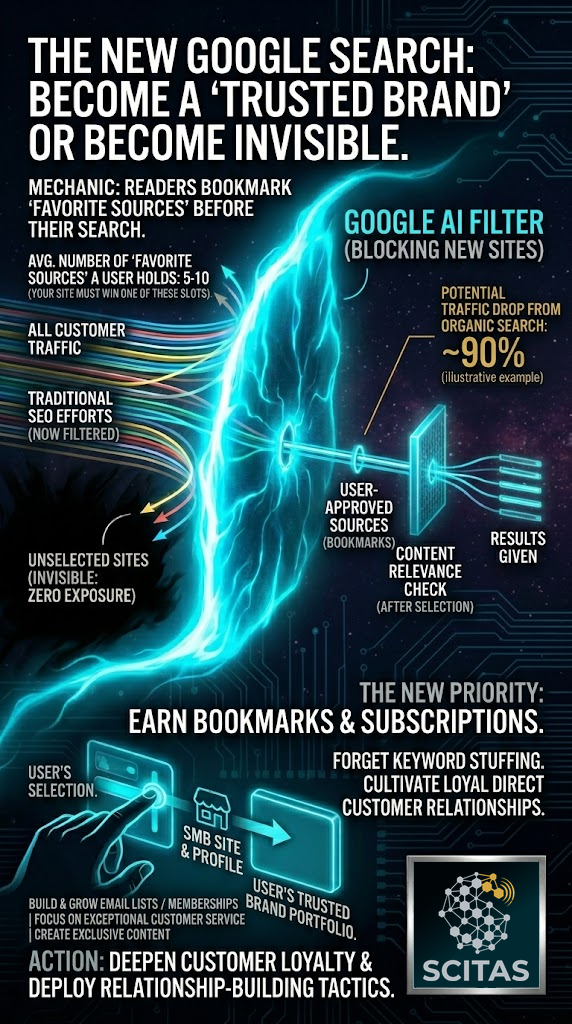
What Exclusion Costs
The traffic model for SMBs has always been: rank, get clicked, convert. AI Mode introduces a new first gate: cite or be bypassed. A business that ranks on page one but is not cited in the AI response loses the click to the response itself. The user reads the answer, does not need to visit any page, and exits.
For informational queries — product comparisons, local service decisions, how-to guidance — this is the majority of search intent. Those are the queries SMBs historically captured through blog content and FAQ pages. The AI Mode response now absorbs that intent without routing the user to the source.
The measurable impact is a reduction in organic traffic for informational content even when ranking positions are unchanged.
What Changes to Fix It
Three changes move a website from absent to cited. First, restructure content around specific answerable questions rather than topics. A page titled “Accountancy Services” does not expose an answer. A page with a heading “What does a sole trader need to file for self-assessment?” exposes one directly.
Second, add structured markup. FAQ schema, HowTo schema, and Article schema with author and organisation entities give Google’s parsers explicit signals about what each block of content represents and who it comes from.
Third, build consistent entity presence. AI Mode cites sources it can verify. A business with a complete Google Business Profile, consistent NAP data across directories, and a clearly attributed author across its content is a verifiable entity. A business that exists only on its own website is not.
None of these changes require rebuilding the site. They require auditing current content against what AI Mode needs to read, and making targeted structural edits to surface answers that the AI can attribute with confidence.
