
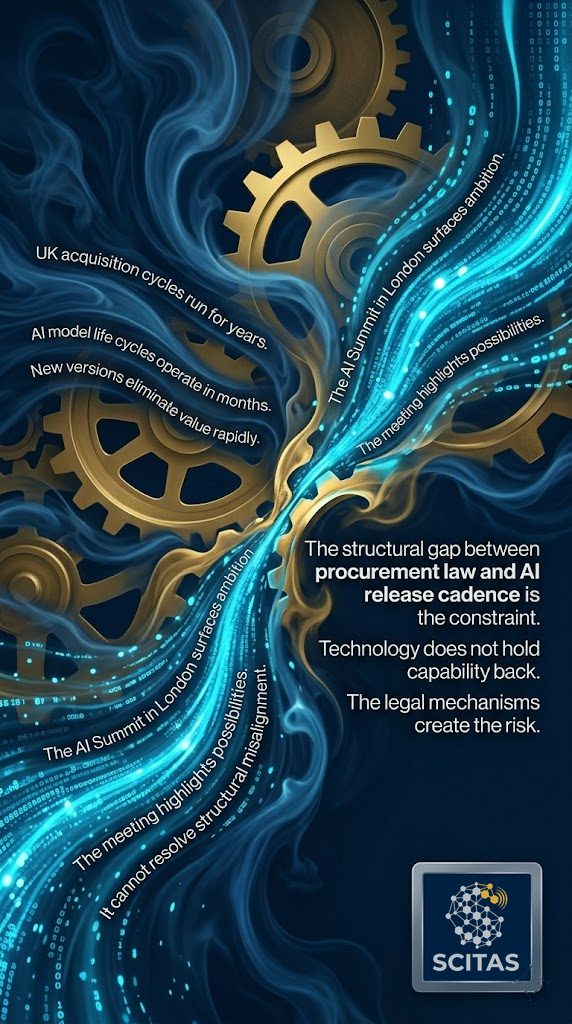
UK armed forces operate on acquisition timelines measured in years. The Ministry of Defence’s Defence and Security Industrial Strategy sets out procurement processes designed for systems with operational lifespans measured in decades. A Type 26 frigate programme runs across political cycles. An armoured vehicle replacement takes the better part of a decade from requirement definition to in-service date.
Commercial AI models have useful operational lifespans measured in months.
GPT-4 was superseded within a year. Claude 3 Opus gave way to Claude 3.5 Sonnet within months of release. Google’s Gemini roadmap accelerates every quarter. This is not a temporary transitional phase. It is the structural operating tempo of the commercial AI industry, and it shows no sign of slowing.
The AI Summit in London surfaces the ambition to close the gap between these two worlds. What it does not surface is the structural incompatibility that makes closing that gap genuinely difficult.
What Defence Acquisition Law Requires
The UK’s Defence Acquisition Framework requires that any system procured for operational use pass formal acceptance testing against contractual performance specifications established before the build phase begins. These are not advisory targets. They are contractual obligations. A system that fails acceptance testing is not paid for. A supplier who cannot reproduce acceptance test conditions cannot demonstrate compliance.
This framework exists for legitimate reasons. It protects the Crown from paying for systems that do not perform. It forces suppliers to commit to measurable outcomes rather than marketing claims. It creates a legal record of what was specified, what was tested, and what was accepted.
The framework was designed for deterministic systems: a radar that detects targets at a specified range under specified atmospheric conditions, a communications system that maintains link integrity at a specified bit error rate. These are systems where performance can be defined precisely, measured reproducibly, and compared directly against a contractual standard.
What Commercial AI Release Cadence Looks Like
Commercial large language models and AI systems do not ship as static, versioned artefacts with fixed performance characteristics. They ship on rolling release cycles. Performance drifts between versions as base models are updated, fine-tuning pipelines are refreshed, and inference infrastructure changes. The benchmark scores published for a model at release do not characterise the same model six months later.
This is not a flaw in commercial AI development practice. It is a deliberate architectural choice that reflects the economics of the commercial AI market. Continuous improvement retains customers and forces competitors to respond. Frozen-version deployment is the exception, not the norm, and even where versions are nominally frozen, the surrounding infrastructure, safety filters, and rate limiting continue to change.
The practical consequence is that a defence system built on a commercial AI component cannot be guaranteed to behave identically at acceptance testing and at operational deployment, much less at the midpoint of a ten-year operational life.
Why These Two Delivery Models Are Architecturally Incompatible
Defence acceptance testing requires deterministic outputs under reproducible test conditions. Commercial AI delivers probabilistic outputs from models with version-shifting performance characteristics. These two requirements cannot be simultaneously satisfied using commercial AI in its standard commercial deployment model.
The problem compounds over time. A contractual acceptance test written today against a commercial AI component specifies performance that may be exceeded by a successor model within twelve months. That successor model may also introduce performance regressions in capability areas that were not tested because they were not included in the original specification. The acceptance test framework has no mechanism to catch this.
The integration risk is not theoretical. It mirrors challenges seen in commercial software procurement when cloud SaaS services replaced on-premise deployments: the service kept changing, the contract did not, and the gap between contracted specification and delivered service widened until it became a contract dispute. AI introduces the same dynamic at the level of core functional behaviour rather than just the user interface.
What the AI Summit Agenda Misses
The AI Summit frames the UK defence AI challenge as a question of investment, talent, and political willingness to adopt new technology. These are real constraints. They are not the binding constraint.
The binding constraint is that no amount of investment resolves the structural mismatch between a procurement framework built for deterministic systems and an AI industry built on continuous probabilistic improvement. Faster procurement timelines, more innovation-friendly contract vehicles, and ring-fenced AI budgets all accelerate the collision. They do not resolve it.
What Would Actually Close the Gap
Three structural interventions are worth considering for defence programmes planning AI integration in Q3 2026 and beyond.
The first is frozen-version contractual deployment. Any commercial AI component integrated into a defence system must be contractually locked at a specific version, with the vendor committed to maintaining that version in an accessible, testable state for the duration of the contract. This is technically feasible but commercially unattractive to vendors whose business model depends on continuous deployment.
The second is sovereign model development. A model developed entirely within UK government infrastructure, trained on data that does not leave a classified environment, and released under a versioning regime that mirrors software release practices, can in principle satisfy acceptance test requirements. The infrastructure investment to build this capability is material. DSTL and its partners have begun this work. It will not be available at scale before 2028 at the earliest.
The third is contractual performance locking with independent verification. Rather than specifying which AI model a system uses, contracts could specify measurable performance outcomes and require annual independent verification that the integrated system continues to meet those outcomes through any model changes. This shifts the risk back to the supplier and creates a contractual mechanism for detecting performance drift. It requires building a testing infrastructure that does not currently exist in UK defence.
None of these is cheap. All of them are cheaper than the alternative: deploying commercial AI into operational defence systems under procurement frameworks that cannot detect when the system stops performing as contracted.
